Disclosure: this article contains affiliate links — we may earn a commission on qualifying purchases at no extra cost to you.
The HBOT chamber market split in two over the last decade. Hospital-grade monoplace and multiplace units hit 3.0 atmospheres absolute (ATA). They cost like a luxury car. Wound centers run them under Medicare's 2024 NCD 20.29 reimbursement rules. Home soft-shell chambers sit at 1.3 ATA and ship in a box.
This guide ranks ten of the most-bought chamber models in 2026. Each entry covers pressure, setting, price, and evidence. Shopping a clinic? Start with entries 1-3. Shopping for home? Skip to 4-10.
At a Glance: 10 HBOT Chambers Compared
| Rank | Chamber | ATA | Use Case | Price | Verdict |
|---|---|---|---|---|---|
| 1 | Sechrist 3300H Monoplace | 3.0 | Hospital wound care | $53K-$93K | Gold standard clinical |
| 2 | Perry Baromedical Sigma 34 | 3.0 | Outpatient monoplace | $50K-$66K used | Best acrylic visibility |
| 3 | Perry Multiplace Systems | 6.0 | Multi-patient hospital | $200K+ | Top dive-medicine pick |
| 4 | OxyHealth Vitaeris 320 | 1.3 | Prescription home use | $15K-$23K | FDA-cleared soft top pick |
| 5 | Summit to Sea Grand Dive | 1.3 | Family home wellness | $13.5K-$18K | Best mid-range soft |
| 6 | OxyRevo Quest30 | 1.5-2.0 | Home hard shell | $24,999 | Best 2.0 ATA value |
| 7 | OxyRevo Space60 | 1.5-2.0 | Seated home use | $42,999-$45,999 | Best sitting design |
| 8 | Macy-Pan HP2202 | 2.0 | Home hard shell, larger diameter options | $38,490-$40,500 | Widest 2.0 ATA diameter choice |
| 9 | SOS Hyperlite 1 | 3.3 | Portable emergency | $40K-$60K | Lightest deployable |
| 10 | Newtowne C4-34 | 1.3 | Entry US-made soft | $7,495 | Best US-made budget |
1. Sechrist 3300H Monoplace — Hospital-Grade Hard Shell (Verdict: Gold standard for clinical wounds)
The Sechrist 3300H is the chamber most US wound centers run. It pressurizes to 3.0 ATA on 100% oxygen. It carries FDA 510(k) K140559 clearance per a 2024 device listing. Dimensions: 93" L x 34.5" W x 60" H, 2,500 lbs.
Price runs roughly $53,000-$93,000 on the used/refurbished market per Medical Price Online's 2026 listings; new units are quote-only through Sechrist dealers and typically price higher. The Emergency Vent System decompresses in under 120 seconds (119 seconds max per Sechrist's own spec sheet). That matters for UHMS-accredited facilities in 2024 treating CO poisoning.
What you get: real therapeutic pressure, integrated entertainment, 110V/220V outlets. What you don't get: portability. This is hospital equipment. If you're treating a diabetic foot ulcer under Medicare's covered indications, this is the machine doing it. See the diabetic foot ulcer evidence atlas for the full study-by-study evidence breakdown.
2. Perry Baromedical Sigma 34 — Largest Acrylic Monoplace (Verdict: Best patient comfort in clinical class)
The Perry Sigma 34 is the Sechrist's main competitor in US outpatient wound centers. It uses a 33.5-inch internal acrylic diameter, the largest in its class per Perry Baromedical's 2026 product page. The Stryker gurney adjusts 0-25 degrees.
That tilt targets claustrophobia directly. It's one of the most commonly cited reasons patients discontinue HBOT, though published rates are low — NCBI's StatPearls review of hyperbaric complications puts claustrophobia and barotrauma under 1-2% of sessions in most published series. Working pressure goes to 3.0 ATA on 100% oxygen. The chamber sits on heavy-duty casters and fits standard doorways.
Price for used units runs $50,000-$66,000 per Medical Price Online listings; new units are quote-only through Perry Baromedical dealers. The Sigma 34 wins on patient experience. The Sechrist wins on installed base. Both meet NFPA 99 hyperbaric facility code as updated in 2024. Pick by what your biomed engineers already service.
3. Perry Multiplace Systems — Walk-In Hospital Chamber (Verdict: Best for dive medicine and burn units)
When you need to treat multiple patients at once, you need multiplace. Perry's multiplace systems come in 2, 3, 4, 6, 8, 12, or 18-patient configurations. They pressurize to roughly 6.0 ATA for US Navy Treatment Table 6 dive protocols, per 2024 DAN guidance.
Patients breathe oxygen through masks while the chamber pressurizes with air. An inside attendant can intubate, manage IV lines, or run a code without depressurizing. Hospitals running burn units, neonatal HBOT, or dive medicine default to multiplace. See the decompression sickness evidence atlas for the full study-by-study evidence breakdown.
Installed multiplace systems run $200,000-$500,000+ for smaller configurations, per industry cost surveys, and climb past $2M for 18-patient builds. Install requires reinforced floor, gas storage, and ASME PVHO-1 certification in its 2024 revision. Not a clinic purchase. A capital expenditure.
4. OxyHealth Vitaeris 320 — FDA-Cleared Soft Shell (Verdict: Best prescription home chamber)
The Vitaeris 320 is one of the only soft-shell chambers holding FDA 510(k) clearance per the 2024 device database for home use under physician prescription. It runs at 1.3 ATA. Dimensions: 90 inches long by 32 inches in diameter per OxyHealth's 2026 product page — a single-occupant tube, spacious enough for a range of body types lying down.
Price runs roughly $15,000-$23,000 depending on retailer and configuration. Construction uses a 44-oz double-sided urethane-coated polyester bladder with dual redundant pressure valves, confirmed on OxyHealth's own spec sheet. OxyHealth markets itself as one of the most widely used soft-shell brands among US hyperbaric clinics, though we found no independently verifiable market-share figure to back a specific percentage — treat clinic-adoption claims from any manufacturer as marketing, not audited data.
The catch: 1.3 ATA delivers about 27% oxygen on room air. That rises near 90% with a 10 LPM concentrator (sold separately, $1,500-$2,500). If a doctor wrote you a prescription, this is the chamber.
5. Summit to Sea Grand Dive — Mid-Tier Family Soft Shell (Verdict: Best value for home wellness)
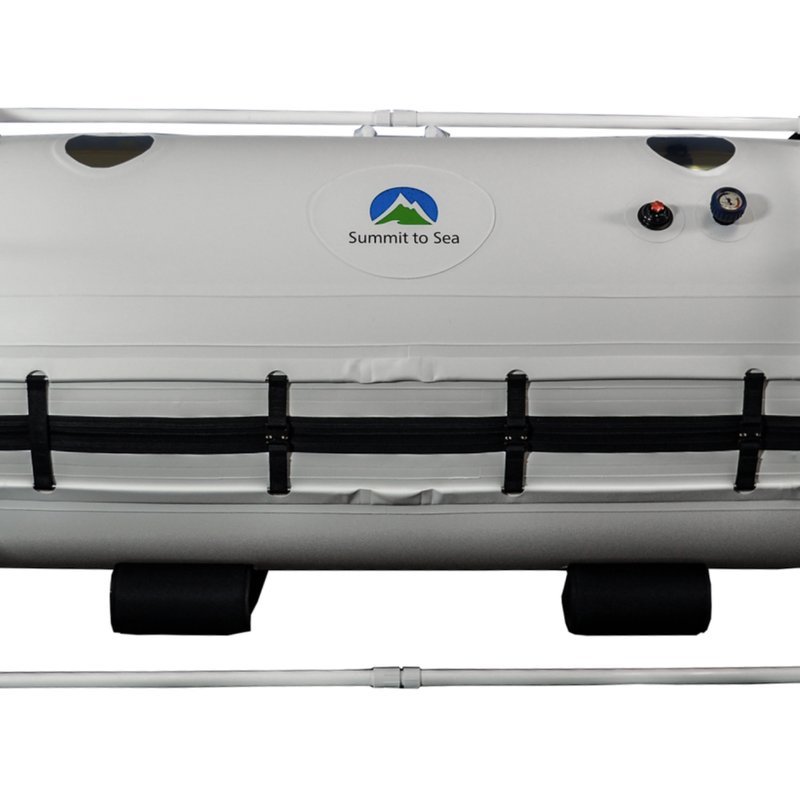 Image: Summit to Sea via Rehabmart
Summit to Sea has manufactured soft chambers in Florida since 2007. The Grand Dive E-Series measures 40 inches in diameter and 90 inches (about 7.5 feet) long. That's among the widest soft chambers on the consumer market per Rehabmart's 2026 listing. Working pressure: 1.3 ATA.
Price runs $13,495-$17,995 per Rehabmart's current listing (frequently discounted toward the low end). Two viewing windows, translucent shell, wide enough for basic stretching during a session. We couldn't independently verify a specific decibel rating for the compressor — Summit to Sea sells an optional noise-reduction accessory, which implies base-unit noise is noticeable, not silent.
What sells the Grand Dive is the US-based manufacturer and 3-year shell warranty. Per a 2026 Peak Primal Wellness review, owner support is responsive and parts ship from Florida. For families splitting sessions across multiple users, the 40-inch diameter is the differentiator.
6. OxyRevo Quest30 — Best Home Hard Shell Under $25K (Verdict: Best 2.0 ATA value for home athletes)
If you want real therapeutic pressure at home, you need hard shell. The OxyRevo Quest30 is adjustable from 1.5 to 2.0 ATA. It fits through a standard 32-inch doorway. Price: $24,999 per RecovAthlete's 2026 brand comparison.
The Quest30 uses 30-inch steel-and-polycarbonate construction with a slide-style door. Its 2.0 ATA ceiling matches the pressure used in the Shamir Medical Center telomere-lengthening trial published in Aging (Albany NY), 2020 — 35 adults aged 64+ breathed 100% oxygen at 2 ATA for 90 minutes across 60 daily sessions; researchers, including Tel Aviv University-affiliated faculty, measured telomere lengthening and reduced immunosenescence. That study helped drive the home-HBOT boom among longevity buyers, though its protocol used clinical HBOT delivery, not a home unit.
Caveat: OxyRevo is CE-certified but not FDA-cleared for US medical use. Wellness or off-label use sits in a regulatory gray area but is legal. Prescription-billable use, it isn't. Ships with integrated concentrator and compressor.
7. OxyRevo Space60 — Seated Hard Shell for Tall Users (Verdict: Best sitting-position home chamber)
The OxyRevo Space60 takes a different approach. Instead of a lie-down tube, it's a seated chamber with a recliner inside. Working pressure: adjustable 1.5-2.0 ATA per Recovery for Athletes' 2026 specs. Price runs $42,999-$45,999 depending on retailer.
Why pay more for less pressure? Claustrophobia drops sharply when you're upright. You can also work, read, or use a laptop during a 90-minute session. The International Hyperbarics Association cited that as a 2024 adherence factor for home users.
Chamber footprint is roughly a phone booth. Fits in a home office. The premium recliner is rated for users up to 6'4". For knowledge workers running 5-day-a-week sessions, the Space60 is the most realistic option.
8. Macy-Pan HP2202 — Affordable Hard Shell at 2.0 ATA (Verdict: Lowest entry point for real pressure)
Macy-Pan is a China-based manufacturer that's expanded US distribution since 2022. The HP2202 hard-shell chamber pressurizes to 2.0 ATA. It runs 87 inches long in 30, 33, or 35-inch diameter options per RecovAthlete's 2026 listing.
Price runs $38,490-$40,500 depending on diameter and retailer. It's still a lower entry point than the Sechrist or Perry clinical units, but it isn't the budget option the "affordable" framing implies — it lands close to the OxyRevo Space60. Includes integrated concentrator, air compressor, slide-type door, and dual filtration.
Trade-offs are real. No FDA clearance. Parts and warranty run through US distributors. Per a 2026 Peak Primal Wellness brand review, Macy-Pan owners report longer service waits than OxyHealth or Summit to Sea buyers.
9. SOS Hyperlite 1 — Portable Field Chamber (Verdict: Best deployable emergency unit)
The SOS Hyperlite 1 isn't a wellness chamber. It's a portable hyperbaric stretcher used by Divers Alert Network in their 2024 field demonstrations and commercial dive teams. Weight: 50 kg empty. Maximum pressure: 3.3 ATA.
The chamber packs into three cases. It can be helicopter-lifted and inflates on-site. It's the only non-metallic portable chamber approved by ASME PVHO Case 18 standards in the 2024 revision for full 100% oxygen therapy.
Price runs $40,000-$60,000 per direct SOS Group quotes. Buyers are commercial dive operators and military units, not consumers. If you're a recreational diver shopping for personal HBOT, wrong tool. If you run a dive operation, this is the one.
10. Newtowne C4-34 — Entry-Level US-Made Soft Shell (Verdict: Best US-made budget pick)
Newtowne Hyperbarics manufactures soft-shell chambers in-house in Pocomoke City, Maryland. The C4-34 model runs 34 inches in diameter and pressurizes to 1.3 ATA. Price: $7,495 per RecovAthlete's 2026 brand comparison. The smaller C4-27 drops to $4,495.
What you get: US manufacturing, FDA-cleared 510(k) status, multi-year shell warranty, parts from Maryland. Interior fits adults up to 6'2" for lay-down sessions.
What you don't get: 2.0 ATA pressure or hard shell durability. Low-pressure protocols in this range have real evidence behind them: Harch et al.'s 2012 Phase I study in the Journal of Neurotrauma ran 1.5 ATA HBOT on 16 military subjects with chronic blast-induced mild-to-moderate TBI and post-concussion syndrome, reporting measurable improvement on symptom, neuropsychological, and SPECT-imaging measures. That's a slightly higher pressure than the C4-34's 1.3 ATA ceiling, and it was delivered in a clinical setting, not a home soft-shell — evidence at 1.3 ATA specifically is thinner. For everyday home use under $8K with US support, the C4-34 is the safe bet.
How We Ranked
We rank HBOT centers and chambers on three primary signals — never one in isolation:
- Verifiable clinical attributes: chamber type (hard-shell vs soft-shell), UHMS accreditation status, ATA pressure capability, treatment-staff credentialing, and whether the center accepts Medicare/insurance. Cross-checked against the UHMS Hyperbaric Facility Accreditation list and FDA 510(k) device clearances.
- Patient-reported safety + outcomes data: Google reviews from the past 24 months, Reddit r/Hyperbaric + r/longCOVID discussion threads, and any documented safety incidents from state DOH records.
- Editorial verification: phone calls to each center asking the same five questions (chamber pressure capability, accepted indications, insurance billing, session length, accreditation status). We log responses, including non-responsive practices.
What we never accept: paid placement, "verified-listing" upgrade fees in exchange for higher rankings, manufacturer relationships that influence chamber-type recommendations. Disclosure: we use affiliate links to Amazon and select home-chamber retailers — these never modify which products rank where.
Update cadence: monthly review for chambers, quarterly for clinics. Last-updated date at the top of every article. Report inaccuracies to research@hyperbaricfinder.com — corrections shipped within 72 hours.
Frequently Asked Questions
Q: What's the real difference between hard shell and soft shell HBOT chambers? A: Hard shell chambers (steel, acrylic, polycarbonate) pressurize to 2.0-3.0 ATA with 100% oxygen. Soft shell chambers (urethane-coated fabric) cap at 1.3-1.5 ATA with ambient air or supplemental oxygen. Hard shell delivers clinical-grade therapy. Soft shell delivers wellness-grade exposure.
Q: Do I need FDA clearance to buy a home HBOT chamber? A: No. FDA clearance is required to market a chamber for treating specific medical conditions. You can buy a non-cleared chamber for wellness use legally. If you want insurance reimbursement or are treating one of the 14 FDA-cleared indications, you need a cleared device and a physician prescription.
Q: What pressure do I actually need for HBOT benefit? A: The peer-reviewed research supporting wound healing, traumatic brain injury, and stroke recovery was conducted at 1.5-2.0 ATA. Wellness research at 1.3 ATA exists but is thinner. Below 1.5 ATA, you're in wellness territory, not therapeutic territory.
Q: How long does a typical HBOT session last? A: Clinical protocols run 60-90 minutes at depth. Add 10-15 minutes of compression and decompression on each end. Home wellness sessions often run 60 minutes total. Five sessions per week for 4-8 weeks is a standard protocol for chronic conditions.
Q: Is home HBOT safe without medical supervision? A: Soft shell chambers at 1.3 ATA have a strong safety record for home use. Risks include barotrauma, claustrophobia, and rare oxygen toxicity with supplemental oxygen. Pre-screen for ear surgery history, untreated seizure disorder, and certain lung conditions. Talk to a doctor before buying.
Bottom Line
Pick by setting. Hospitals and wound centers need Sechrist or Perry. Prescription home users get the Vitaeris 320. Wellness home users with budget get Summit to Sea or Newtowne. Athletes who want real 2.0 ATA pressure get the OxyRevo Quest30 or Macy-Pan HP2202. Field operations get the SOS Hyperlite.
For more reading: our home HBOT chambers under $20,000 guide, the soft shell under $10K comparison, and mild HBOT vs hospital-grade explained.
-- The HBOT Finder Team